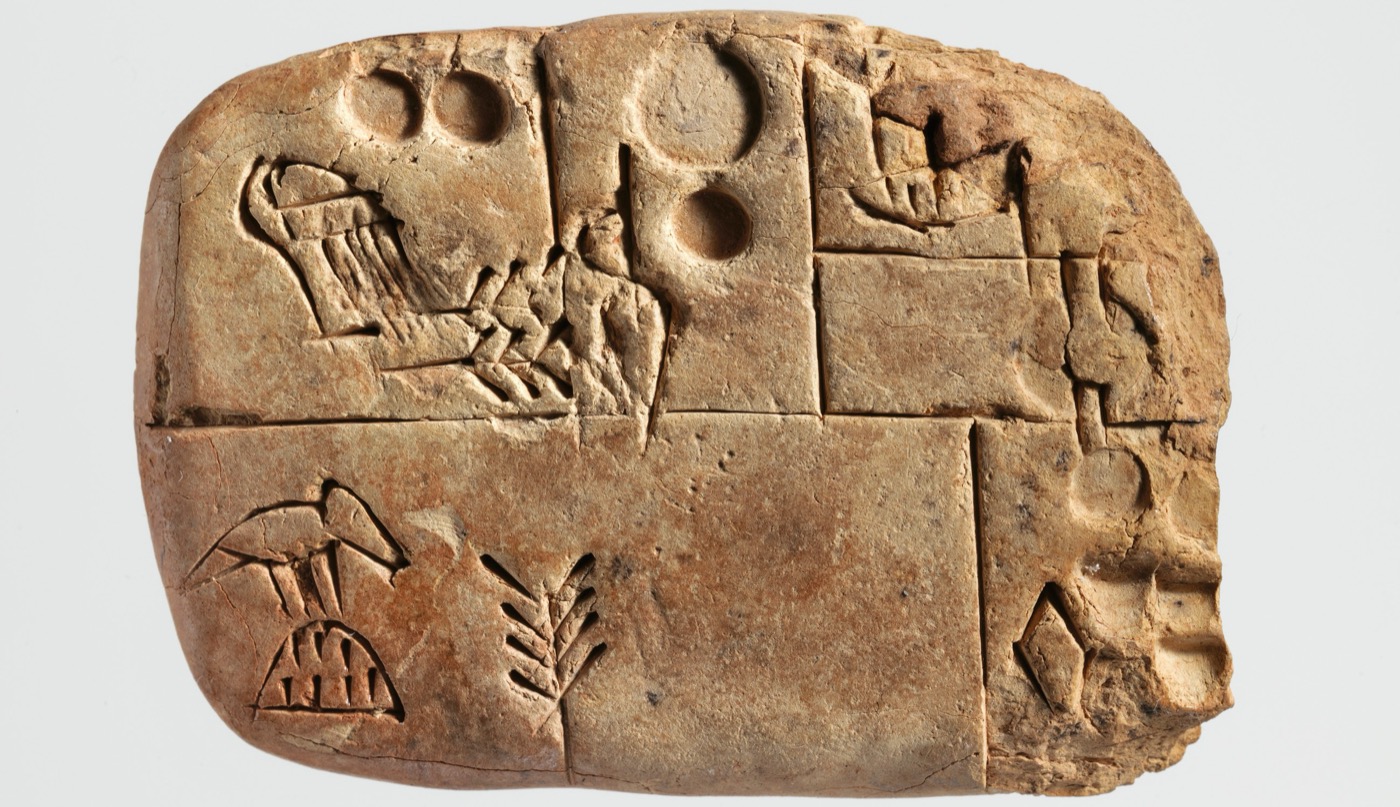
Philadelphia has many libraries. In its biggest Library, Parkway Central, there is a quiet room on the fourth floor dedicated to rare books. The room is usually empty. Victorian novels sit bound in dyed leather behind glass covers. There are etchings made by the Pennsylvania Amish, medieval manuscripts impressed upon animal hide, and even the taxidermied raven said to have inspired Edgar Allen Poe’s famous poem, “The Raven.” Underneath the room’s central display, there is a collection of delicately etched rocks. The rocks are some of humanity’s first known instances of expressing their spoken and signed languages on a surface, i.e. some of the first known artifacts of writing.
The first time I visited the rare book department, I had just started working for the library as a data analyst. I was entranced. The writing blocks were so simple and old. As I learned from the display case’s placard, the rocks are actually pieces of clay, carved with reed styluses by Sumerian scribes. They are artifacts of humanity’s first civilization, Mesopotamia, which formed along the banks of the Tigris River in modern-day Iraq around 5000 B.C. Sumerians developed their writing system, known as Cuneiform, around 3000 B.C. Sumerians made clay by sifting out the pebbles from the mud of river beds. They whittled sturdy stalks of reed to make their pens. When scribes completed their engravings, they then baked the clay in sun or fire.
The initial purpose of this Cuneiform writing system was for record-keeping. Scribes wrote down government announcements, taxes paid, trade activity, etc. As a data professional, I was charmed to learn during my first visit to the rare book department that Sumerian scribes and I were essentially solving the same common problem: how to track everything that’s happening at an organization. How many baskets of grain arrived from the farms yesterday? The day before? How many books were returned to the South Philly Library branch over the previous two-week stretch? I like to think the first person to write something down was, like myself, very forgetful. Writing, data analytics, any information technology really—these are ways of storing memories outside of yourself.
While I’ve since moved on from my position at the Free Library, I still think constantly about its Cuneiform collection (they are my Roman Empire, you could say). I think about how humanity’s systems of signs have evolved since then. In 3000 B.C., symbols encoded basic concepts: a debt owed, a unit of livestock. Later, humans developed alphabets and syllabaries to encode the grammars and words of spoken languages into text. Paper, ink, and the printing press made it possible to store and distribute information at large scales. Computers became defining elements of our modern communication. With the rise of artificial intelligence, the memories we store outside ourselves are no longer static. Written language now speaks of its own accord.
Does it make sense to call writing an invention? Will our systems of writing continue to evolve beyond artificial intelligence? As an English major, I sometimes wonder how I ended up working in data, but when I dwell on this history of writing, I find comfort in the common history of literature and data. Everything emerges from reed and clay. Whether coding or journaling, we can all marvel at the past and future of written communication and feel sentiments of kinship with our ancient predecessors, who walked along the tributaries of the Tigris, wondering what it could mean to symbolize your memories for someone else.